The Power of Thought
“Whether you think you can or think you can’t, you’re right”. Henry Ford
The Thought-Feeling Connection
I find myself returning to this statement often. What we think plays a powerful role in how we feel—both physically and mentally—and, in turn, how we behave and experience the world around us. Considering that humans average more than 6,000 thoughts a day (https://www.queensu.ca/gazette/stories/discovery-thought-worms-opens-window-mind), that’s a lot of thinking, feeling, and reacting.
Many of these thoughts arise quietly, almost unnoticed. Yet they shape our internal landscape—how our body feels, how we respond emotionally, and how we move through the day. But have you ever wondered: how many of these thoughts are actually based in fact? How many are truly 100% true from beginning to end?
Through my own mindful practice, I’ve discovered—not many.
And if the majority of our thoughts aren’t entirely true, yet we react to them as if they are, it makes sense that so many of us feel stressed, anxious, exhausted, or experience physical symptoms. The body responds as though the story is real.
The good news is, this cycle is not fixed: each thought creates an opportunity for awareness, without judgment—an invitation to relate differently, and to let go of what isn’t true.
Thoughts are not who we are. They are simply thoughts—and they are meant to arise and pass.
What we pay attention to, and practice, grows.
When we become over-focused on a thought due to its’ association with an uncomfortable bodily sensation -i.e. what we judge to be an unpleasant emotional state- we can unknowingly reinforce it. Over time, repeated thoughts and behaviors become familiar pathways. They shape how we relate to ourselves and our experiences, how we behave, and also our beliefs about the world.
Humans are social beings and we are wired for connection and belonging to the social group. Therefore, how others consistently respond to us in a given situation can shape both our behavior and our beliefs. These belief systems are often formed early in life and become embedded within our internal ‘operating system’ often outside of our conscious awareness. For example, if a child is only affirmed when they perform well, they may form the belief that approval is conditional on perfection or achievement. As adults, we then begin to view the world through this lens—often overlooking moments of genuine connection or affirmation that don’t align with this deeply held belief.
I’ve observed this pattern in my own life.
As a young child, my learning was driven by curiosity. I loved understanding how things worked and experimenting with new ideas. However, a punitive teacher in Grade 2 instilled a fear of making mistakes. I began working relentlessly to ensure my work was perfect, so I wouldn’t be singled out. By Grade 3, I had developed an anxiety disorder. A well-meaning teacher then rewarded my efforts with an award for making no maths mistakes for the entire year. This reinforced the belief that I needed to perform perfectly to be approved of.
Once on this treadmill, I assumed others always expected the highest standard from me. The result was chronic stress and burnout, followed by disengagement and a loss of joy in learning during my final years of school. Looking back, it’s not surprising that anxiety manifested physically—first as gut issues and an overactive bladder, then migraines in secondary school.
At some level, I was aware that this perfectionistic thinking was related to how I felt, but I couldn’t identify the core belief that was driving it, let alone how to dismantle it, until much later. Until I addressed this belief and actively worked with the thoughts feeding it, I remained caught in a cycle of high achievement, stress and anxiety, low mood, hopelessness, and burnout.
While this belief system no longer drives my life, it can still surface-particularly when I step outside my comfort zone or start something new. What’s different now though, is that I have the tools to recognize ‘my story’ earlier, and change my relationship with it, rather than allowing it to take up residence in my mind and compulsively direct my actions.
With awareness, intention and practice, those pathways can change.
The impact of this is reduced stress and an increased sense of wellbeing.
How we relate to our thoughts matters.
When I notice thoughts such as, “I am anxious” or “my anxiety,” I pause and feel into my body. Often there’s a subtle contraction—a holding in the chest or belly. These words can make anxiety feel fixed, woven into identity, when in reality, anxiety is a universal human experience—one that ebbs and flows.
A small shift can change the relationship.
Reframing to “I am experiencing the emotion of anxiety,” or simply noticing the thought and the associated physical sensation in the body (e.g. a dense, moving sensation in my belly), changes my relationship with both the thought and the sensation. Withdrawing attention from the thought and not reacting to the physical sensation allows both to rise and fall naturally.
Observing in this way means that we are no longer defined by the experience nor destined to always feel this way.
Through Mindful coaching, and MiCBT training we begin to:
Notice thoughts without judgment
Observe patterns with curiosity
Choose where to place our attention
Change the habits that reinforce ongoing stress.
Outcome: A natural byproduct of this gentle practice is neuroplasticity—a shift in how the brain is wired—supporting reduced stress and a gradual return toward balance and calm.
What’s your story and what might shift for you if you began meeting your thoughts with curiosity, rather than believing every story they tell?

Further reading:
Tseng, J. & Poppenk, J. (2020). Brain meta-state transitions demarcate thoughts across task contexts exposing the mental noise of trait neuroticism (2020). Nature Communications, 11,
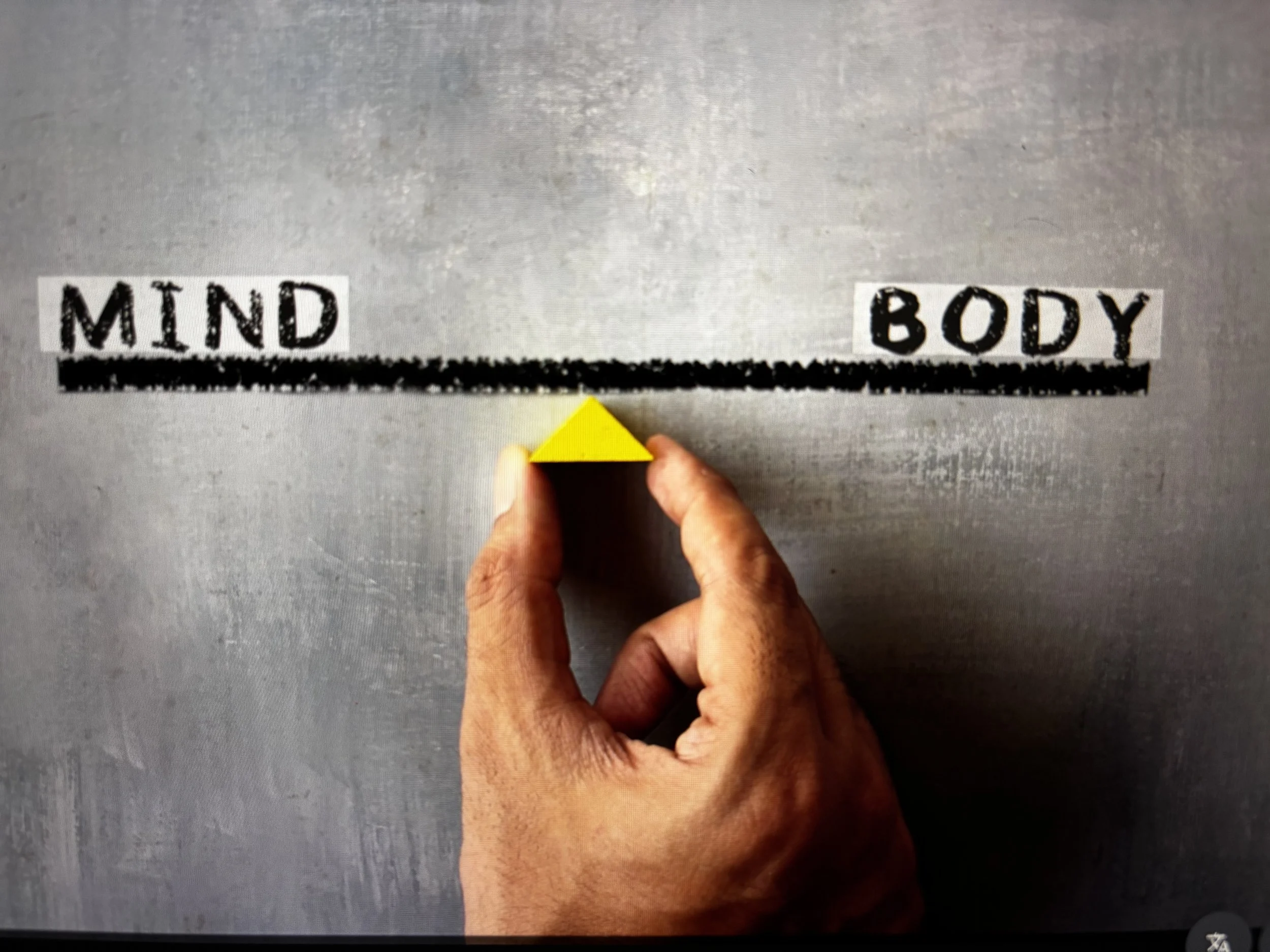
Mind-Body Connection
The body is a complex system, one that is intricate and nuanced. Given the sophistication of many of its essential structures, it makes sense that conventional medical practice has evolved into specialized fields focused on specific organs or systems. If you experience migraines, you are referred to a neurologist. If digestive symptoms arise, a gastroenterologist. For mood changes or psychological distress, a psychiatrist.
This way of organizing care is familiar and often necessary—but it also suggests a division that current evidence no longer fully supports.
Increasingly, research points to a much more integrated system, where the mind and body are continuously communicating with, and influencing, one another. The nervous system plays a central role in this relationship. Through pathways such as the vagus nerve, the body is constantly relaying information about safety, threat, and regulation. This communication influences heart rate, blood pressure, digestion, immune function, and overall physiological stability.
In this ongoing exchange, patterns of thinking and feeling influence physical health and bodily functioning. At the same time, physical states shape mood, thoughts, and emotional regulation. Neither operates in isolation.
I see this often in my work-clients presenting with a history of psychological distress or trauma alongside a long list of physical symptoms, diagnosed conditions, or ongoing health concerns. While these experiences are frequently treated separately, the body tells a more interconnected story.
When we begin to recognize this bi-directional relationship, something important changes. Self-care becomes less about fixing symptoms in isolation, and more about listening to the system as a whole—with curiosity rather than judgment.
Over time, prolonged stress, neurodivergence, parenting demands, major life transitions, and the sustained pressures of work, finances, relationships, or social isolation, can gradually disrupt this balance. Often, the body is the first to signal that something is out of alignment.
These signals may show up as:
Emotional shifts or difficulty regulating feelings
Persistent fatigue or fluctuating energy
Physical symptoms—pain, tension, illness
Changes in motivation, behavior, or capacity for everyday life.
Rather than viewing these signals as problems to eliminate, they can be understood as information—messages from the system asking for attention and appropriate action.
Learning to notice these cues, and to respond intentionally rather than react automatically, is a core component of supporting wellbeing across the lifespan. This approach can also complement medical treatment by reducing stress and creating the internal conditions that allow the body to respond more effectively to this care.
Learning to Listen with Curiosity
By cultivating mindful, non-judgmental awareness, we begin to notice how thoughts, emotions, and physical sensations interact in real time.
This awareness allows us to:
Pause before reacting
Respond with intention
Build new habits and perspectives
Develop sustainable changes that improve overall wellbeing, including our relationships with others and with ourselves.
In other words, we move from autopilot into choice.
Cultivating awareness is an ongoing practice—one that takes intention and that unfolds in everyday moments.
Reflecting on this……
What signals does your body tend to offer when something is out of alignment?
How might your experience change if you learned to respond to those signals with curiosity?
If you would like support in building this awareness and translating it into meaningful, sustainable change, you can book a no obligation discovery session to learn more.
Further Reading
Lipton, B (2016). The biology of belief: unleashing the power of consciousness, matter and miracles. Hay House LLC.